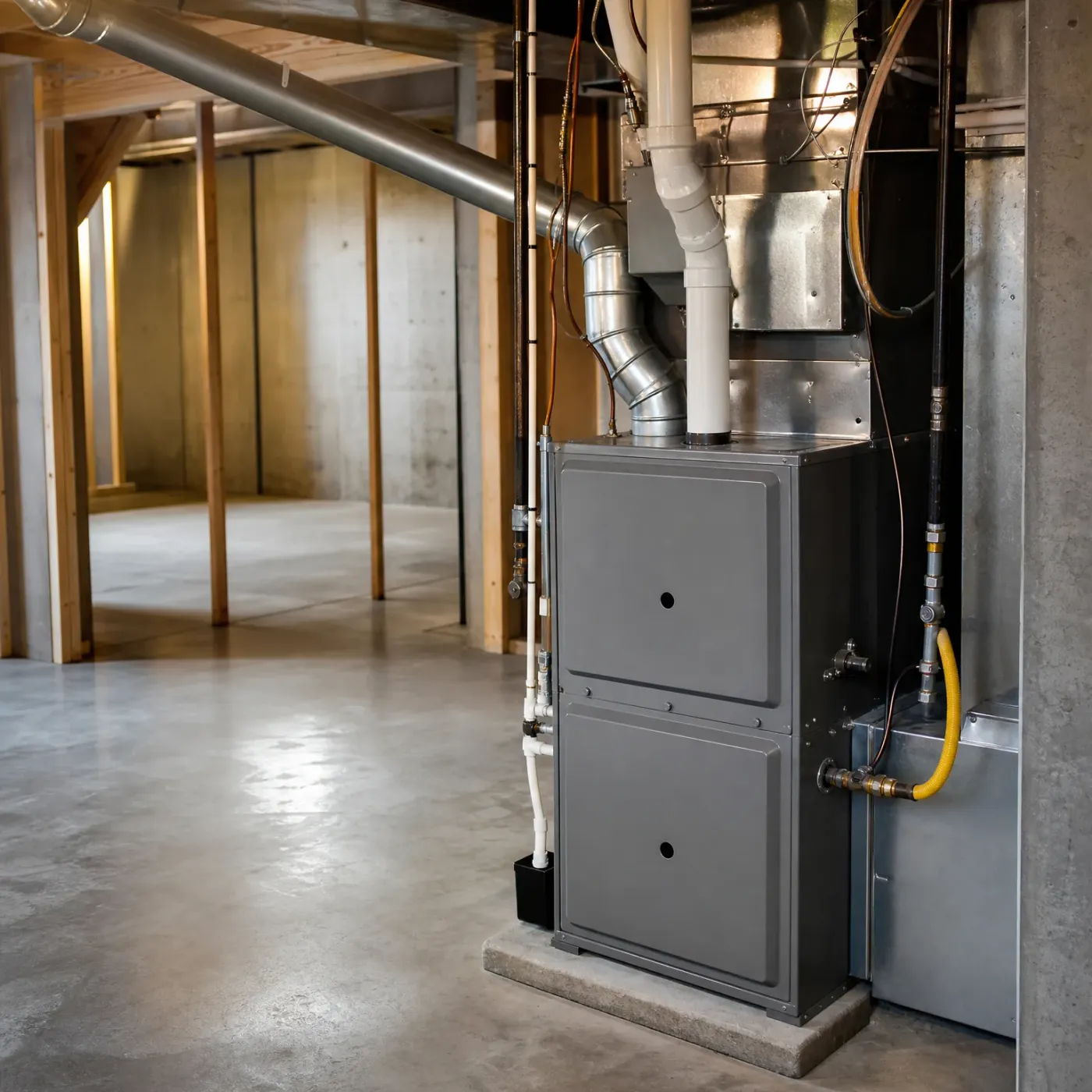

A gray high-efficiency furnace with PVC venting, copper and plastic piping, and a condensate pump sits beside sheet-metal ductwork in a concrete-floored basement.

A pro who works on furnaces

Why your furnace won't turn on in a Massachusetts winter

A furnace that won't start on a cold Massachusetts morning usually comes down to a short list of causes, from the thermostat to the igniter to the gas valve. This page walks through what to check and what it means. If you'd rather not sort through it with the house getting cold, you can get matched with a contractor who handles furnace repair near you.

Find my pro

A furnace that won't turn on usually stops at one of a few points. If the thermostat screen is blank or the furnace doesn't respond at all, check the breaker first, since a tripped one cuts power before the furnace ever gets a signal to start. If the blower runs but no heat follows, or the furnace tries to fire and shuts off, the igniter or flame sensor is often the reason. Older furnaces with a standing pilot can lose that flame to a draft or a dirty thermocouple. Gas furnaces also need the gas valve open and the line behind it working, so a furnace that clicks but never lights sometimes traces back to the gas supply itself. On a Massachusetts morning in January, none of this waits well. A house loses heat fast once the system stops, and a part that's failing often fails again within the day, so it's worth having someone look at it rather than resetting it and hoping.

A gray high-efficiency furnace in a basement, connected to sheet-metal ductwork on the left and white PVC vent pipes above, with black gas and drain piping and an exposed wood-stud wall with OSB sheathing on the right.

Running normally

The furnace fires on command, the inducer motor pulls air through the vent, and the igniter glows before the burners light. Warm air moves through the ductwork on schedule. Nothing needs your attention, and the basement stays quiet except for the normal cycle on and off.


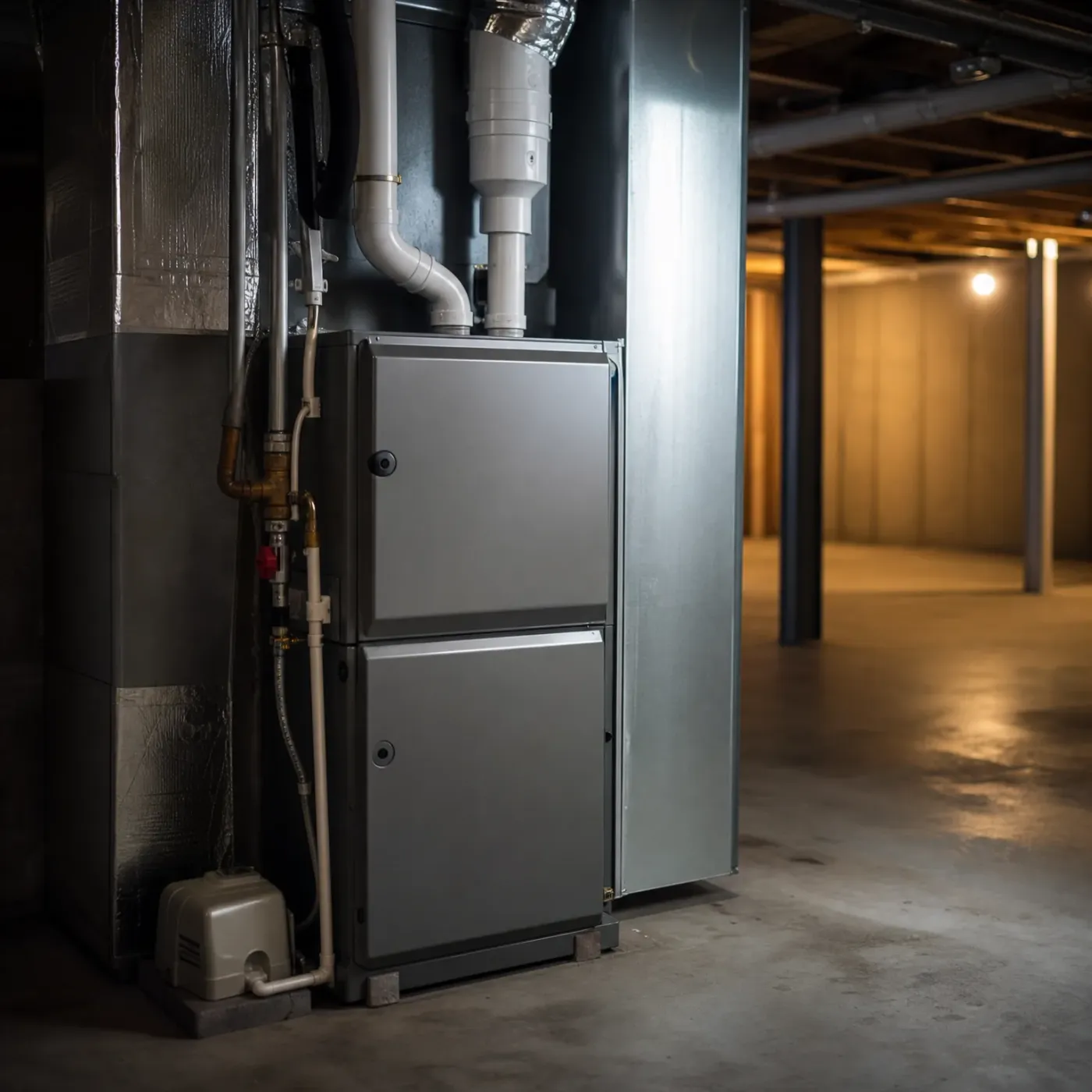
An older gas furnace with two louvered front panels stands on a concrete basement floor beside galvanized sheet-metal ductwork, pipes, and a weathered concrete wall.

Won't start

The furnace sits cold and silent, even with the thermostat calling for heat. Age and moisture work against an older unit like this one, corroding connections and pitting the parts that have to spark or sense a flame. When one of them fails, the whole furnace refuses to start rather than run half right.

Try It Yourself or Call for Repair

Call for repair

  • A licensed contractor can test the gas valve and pressure switch safely, without guessing whether gas is involved.
  • Someone who keeps the house warm all day can't afford to wait on a part that might fix itself or might not.
  • A contractor carries igniters, flame sensors, and control boards on the truck, so the furnace often runs again the same visit.
  • If the furnace trips the breaker repeatedly, that points to an electrical fault that needs a trained eye before it gets worse.
  • A repair gets diagnosed once instead of guessed at twice, which matters when it's 20 degrees outside overnight.

Keep checking yourself

  • Resetting the breaker and the switch on the furnace itself costs nothing and takes under a minute.
  • Checking the thermostat batteries and the setting rules out the simplest cause before anyone needs to be called.
  • A clogged filter restricts airflow and can shut the furnace down on its own safety switch, and swapping it is a five-minute job.
  • If the furnace is still under warranty, opening it up yourself for anything beyond the filter can void that coverage.
  • Gas valves, igniters, and control boards aren't safe to test without the right meter, so that part of the list has a limit.
A woman with dark hair in a bun wearing a cream knit sweater sits on a gray sofa in a bright living room, looking off to the side.
A woman wrapped in a knit blanket sits on a gray sofa in a living room, looking toward a bright window with houseplants and an armchair in the background.
A woman in a gray cowl-neck sweater sits on a light sofa with cushions, smiling and looking to the side, with a kitchen and window visible behind her.
A woman with dark hair in a bun, wearing a light linen shirt, sits on a sofa and looks to the side, with a window, houseplants and a kitchen with pendant lights blurred behind her.
A man in a dark blue shirt stands in an open front doorway of a stucco and wood-clad house, facing a blond woman seen from behind in the foreground on a stone walkway.

A cold house shows up fast in a Massachusetts January

A furnace that won't start doesn't give you a few hours to think it over. Pipes along outside walls are the first thing at risk once the house drops below the mid 50s, and that can happen in one night when it's single digits out. Anyone in the house who's older, very young, or sick feels the cold faster than the thermostat shows it.

You don't have to figure out whether it's the igniter or the gas valve before you get help. Send the form and a licensed contractor who covers your area will reach out to you directly. That's one less thing on your list on a morning when the house is already cold and you have enough to manage.

Interior corner of a dining room with a round wooden table, a ceramic vase holding olive branches, a dark spindle-back chair near a curtained window, and a sideboard with a lamp against beige walls.

Winter nights average 21°F statewide

At 21°F overnight, a furnace that won't restart isn't a minor annoyance, it's a straight drop in house temperature until someone fixes it. That's the average low for a winter night here, not a cold snap. Your furnace is built to run through nights exactly like that.

NOAA nClimDiv 1991-2020 county normals weighted by homes

A gray sheet-metal furnace with flue pipe and adjacent ductwork stands against a stone basement wall on a concrete floor, with white PVC and metal pipes running nearby.
Before you get your furnace repair
A gray high-efficiency furnace with white PVC vent pipes stands against a concrete basement wall beside sheet-metal ductwork, a small condensate pump on the floor, and exposed wood framing at left.
After you get your furnace repair
A gray gas furnace on a concrete pad in an unfinished basement, connected to sheet-metal ductwork, white PVC venting, and a yellow gas line, with concrete walls and wood framing in the background.

Get your furnace to the right pro

Send the request today and let a furnace pro reach out to you.

Tell a local repair pro what your furnace is doing.

Get a furnace pro

You only hire the pro if you want to.

What are you noticing right now in your house

The thermostat is set where it always is and nothing happens. Maybe you hear a click or two from the basement and then silence, or the blower runs but the air coming out is cold. Some rooms feel colder than others, the ones farthest from the furnace. You might smell something faint near the unit, or notice the pilot light area looks dark when it should show a small flame or a glow. A furnace that cycles on and off without warming the house is still not working, even if it's making noise. Left alone overnight in a Massachusetts winter, this isn't just an inconvenience. Rooms lose heat fast, and anyone in the house who's cold is cold for as long as the furnace sits broken.

  1. Thermostat calls for heat and sends power to the control board.

  2. Pressure switch checks the inducer motor is pulling air before gas opens.

  3. Igniter heats up until it glows hot enough to light gas.

  4. Gas valve opens and burners light off the hot igniter.

A smiling older woman with gray shoulder-length hair in a cream cable-knit turtleneck sweater stands behind a wooden board holding a round loaf of bread, in a warmly lit kitchen with a dark window and shelves behind her.
A woman and a child wrapped together in a thick knitted blanket on a sofa, both with eyes closed, with a lit table lamp and houseplant in the dim background.

One Part, One Fix, Heat Back

  • A dead thermostat screen, a tripped breaker, or a bad igniter all land in the same place: no heat until someone finds the one point that failed.
  • Most of these stop points need a meter or a manometer to test safely, especially anything involving the gas valve or pressure switch.
  • The furnace isn't guessing and neither should you; once the cause is found, the fix is usually a single part, not a rebuild.
  • Sending the form hands the search for a contractor to someone else, so you're not the one making calls while the house sits cold.
  • A furnace that's run fine for years can still stop on one worn part, and that part is almost always replaceable on the spot.
  • Once a licensed contractor is on it, the house goes back to the furnace doing its job without you tracking down each step yourself.

A furnace that won't start almost always traces back to one point in the sequence: the thermostat, the breaker, the pressure switch, the igniter, or the gas valve. Each one either does its job or it doesn't, and the furnace stops at the first one that fails. That's the whole answer. It isn't a sign the furnace is wearing out or that something bigger is wrong underneath. A nine year old furnace and a two year old furnace fail at the same handful of points, for the same reasons, and get fixed the same way.

Finding which point failed takes a meter or a manometer in most cases, since a cracked igniter and a stuck pressure switch can look identical from the thermostat. That's testing, not guessing, and it's why this isn't a one by one swap of parts hoping one sticks. Once the failed part is identified, the repair itself is usually quick: a new igniter, a reset pressure switch, a cleared valve.

Sending the form is the last thing you have to do yourself. From there, a licensed contractor takes over tracking down the part and getting the furnace running again, and the house goes back to holding its temperature on its own. You don't have to call around or compare anyone. That part of a cold morning is no longer yours to manage.

A single-story stucco house at dusk with a lit paver walkway lined by low path lights, desert plants and boulders in front, and distant mountains under an orange and blue sky.

Furnace Repair

The right pro for this job

Step 1 of 3: Equipment
  • A cream chunky cable-knit throw draped over a beige upholstered armchair beside a bright window, with a wooden side table holding a book and a vase of leafy branches at left.
    • A local pro who knows furnaces gets your details and gets in touch.
    • Describe your furnace job, and a local pro who handles it gets in touch.
  • Living room corner with a gray sofa holding beige pillows and a knit throw, a round wooden coffee table with a dark planter and shallow bowl, a jute rug, a floor lamp, a framed landscape print on the wall, and a window showing trees.
    • Once you send the form, finding a pro is off your list.
    • After you send the request, you're done searching.
  • A living room corner with a cream sofa and cushion, knit throw, wooden coffee table holding a shallow bowl and dark ceramic vase with green foliage, a floor lamp, potted plant in a woven basket, and linen curtains at a window.
    • Answer a few questions instead of calling shop after shop.
    • Describe your furnace job once, to one pro.
  • A round reclaimed-wood coffee table with a black metal base sits on a woven rug in front of a cream sofa with cushions, with a lit built-in fireplace and a tall indoor tree in the background.
    • The pro who reaches out is licensed in Massachusetts.
    • Only one pro gets your request, so you hear from one company.