

Why one room stays cold in a Massachusetts winter
Get the furnace repair search off your mind today.
Hand it overWhy is one room in my house always cold in the winter?
You keep the thermostat at a normal setting, the rest of the house feels fine, and one room still needs a space heater to be comfortable. In a Massachusetts winter that gap is hard to ignore, especially if it's a bedroom or a room where someone spends most of the day. It's not your imagination, and it's not something you have to live with until spring.
That room isn't getting enough warm air from the furnace to keep up with the heat it loses
Every room loses heat through its windows, walls and roof, and the furnace is supposed to replace that heat through the ductwork. When one room stays cold, either it's losing more heat than the others, usually because it has more exterior walls or a window that faces north, or it's getting less warm air than it needs, often because a duct run is long, a damper is closed partway, or the vent is blocked by furniture. With gas heat running from late fall through early spring here, that shortfall shows up every day, not just on the coldest nights. A contractor can check the airflow at that register against the others and find which side of the problem it is.
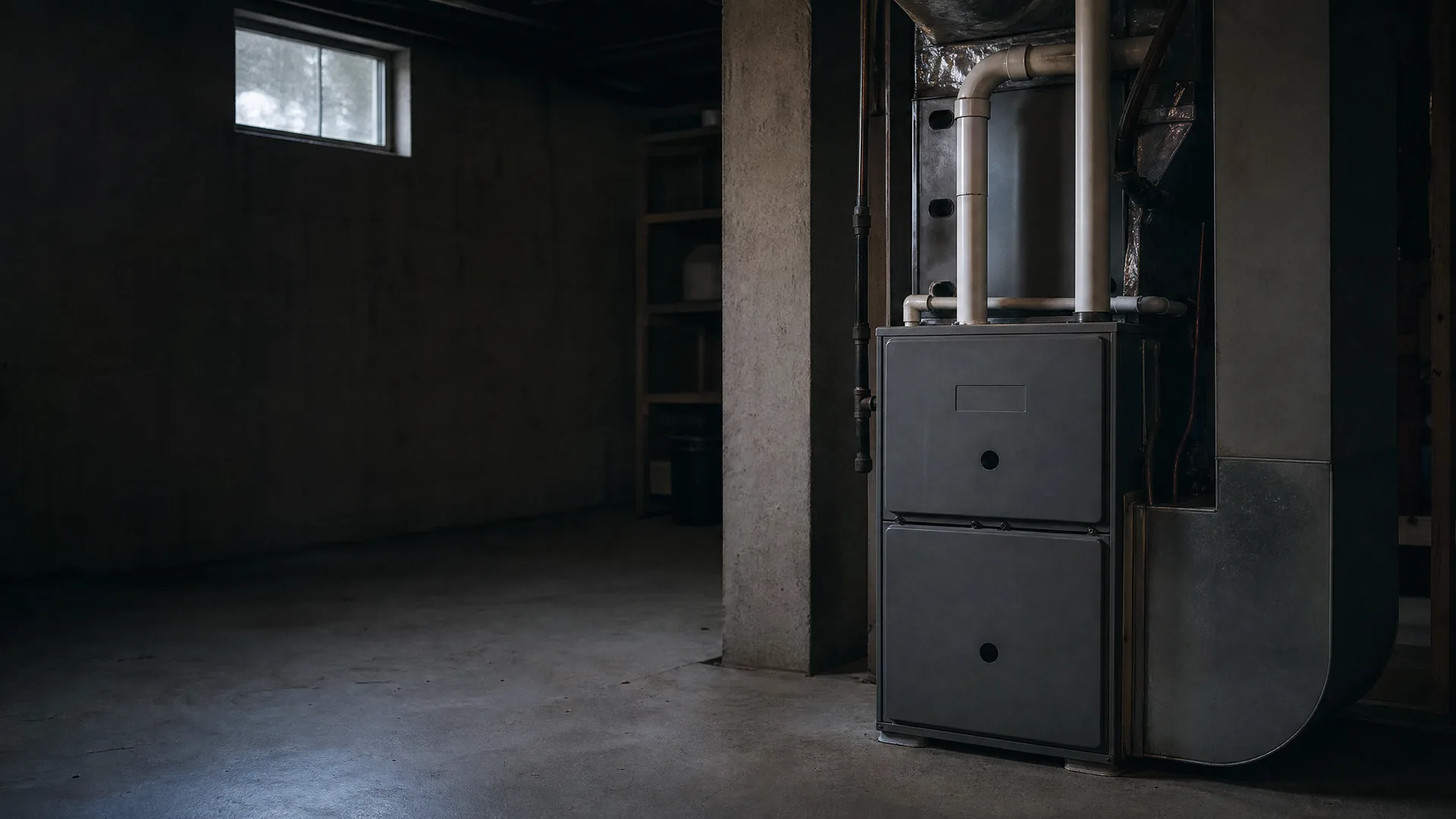
You go down to check the furnace after the kids are in bed, the kitchen upstairs warm, that one bedroom still cold enough for a space heater. It's November, dark outside already by five. The furnace sits there dark and quiet when it should be running. A thin haze of dust hangs in the beam of your phone light, stirred up from somewhere behind the cabinet. You put a hand near the vent and feel nothing. No hum, no click, no warm air anywhere in the house now, not just that one room. You stand there a second, listening for a sound that isn't coming, then go back upstairs for a flashlight.
Is it the ducts or the furnace
A duct problem
- The duct run to that room is longer than the others, so it loses more heat before the air gets there.
- A damper somewhere in the duct is closed or stuck partway, cutting the airflow to that one register.
- The duct has a disconnect or a crushed section behind a wall or in the basement, and the air is leaking out before it reaches the room.
- If the room is over a garage or at the end of the house, the duct run has more exposed length for heat to escape along the way.
- A contractor can check airflow at the register and trace the duct back to find where it's losing heat or air.
A furnace problem
- If the furnace is short-cycling, it may be shutting off before it's pushed enough heat through the whole system to reach the far rooms.
- A weak or failing blower motor moves less air overall, and the room farthest from the furnace feels it first.
- A dirty flame sensor or a clogged filter can cause the furnace to run shorter cycles than it should, leaving less-used rooms underheated.
- If the thermostat is in a different room than the cold one, the furnace may be satisfied before that room gets enough heat.
- A contractor who services furnaces all winter in Massachusetts homes can tell from the cycle length and the blower whether the furnace itself is the cause.

Furnace fires and pushes warm air into the main duct trunk.
Air splits off into branch ducts leading to each room.
The branch run to that room loses heat over its longer path.
A partly closed damper or register throttles what reaches the room.
Is this the room where someone sleeps?
You've probably already closed the door to keep the cold in that one room from spreading, or you've got a space heater running there most nights. Maybe the vent rattles or barely pushes air when you hold your hand to it, while the one in the hallway blows steady and warm. If it's a bedroom, that's the room someone has to sleep in all winter, and a space heater running for hours unattended isn't something to get used to. If it's where your kids do homework, they're the ones sitting in coats. None of this means the furnace is failing. It usually means that one room isn't getting its fair share of the heat the furnace is already making.






Your furnace has one blower speed. It doesn't know one room is cold, it just pushes the same amount of air through the whole system every time it runs. That air has to fight its way through every duct at once, and whatever is hardest to reach loses out first. If the filter's dirty or a duct somewhere is pinched, the pressure drop shows up worst at the far end of the house, usually a room over the garage or tucked at the end of a hallway, farthest from the furnace itself. Getting warm air in is only half the job. Air has to come back out through a return grille, and a room with a weak or blocked return won't circulate right no matter how much the supply vent is pushing. Then there's the thermostat, usually sitting in the hallway, reading only the hallway's temperature. Once that spot hits the set point, the furnace shuts off, whether or not that one bedroom ever caught up.
How Air Pressure Shorts One Room
- A single-stage furnace runs at one fixed blower speed, so it pushes the same air volume whether a room needs a little heat or a lot.
- The blower has to overcome the resistance of the whole duct system at once, not just the run feeding the cold room.
- A return air grille pulls room air back to the furnace, and a room with a weak or blocked return won't circulate air well even with a strong supply.
- Static pressure inside the ducts rises when a filter is dirty or a duct is pinched, and that pressure loss shows up worst at the end of the longest run.
- Rooms over a garage or at the end of the house usually sit furthest from the furnace, so they're first to lose pressure and heat along the way.
- A thermostat in the hallway reads that hallway's temperature only, so the furnace shuts off once the hallway is satisfied even if one bedroom hasn't caught up.


One request and it's handed off
You've probably already tried the easy things, closing other vents, running a space heater, maybe checking that the thermostat isn't the problem. If the room is still cold, something in the duct run or the furnace itself needs a hand that knows what to look for. A damper stuck halfway, a crushed flex line in the basement, a blower that's too weak for the longest run in the house, these aren't things you find by guessing, and with power costs what they are in Massachusetts, running a space heater all winter to cover for it adds up fast. A contractor who works on furnaces in this area all winter has seen this exact complaint before, in houses with the same kind of duct layout and the same gas furnace setup. That's who gets your request, not a handful of companies competing for the job. Send it and let someone who actually knows furnace ductwork take the next look, so that one cold room stops being something you just live with until spring.
What's Actually Happening in the Ducts
- Static pressure builds inside the duct trunk whenever a damper or crushed run restricts airflow downstream.
- A return duct that's undersized or blocked starves the blower of air to push, so far rooms get less of it.
- Heat registers placed on exterior walls lose warmth faster than ones on interior walls, even with equal airflow.
- A furnace short cycling on a cracked heat exchanger or failing limit switch never runs long enough to heat a long duct run.
- Insulation gaps around a duct running through an unheated space, like an attic or crawlspace, let heat bleed out before it reaches the register.
- A blower wheel caked with dust spins at reduced capacity, cutting output to the rooms furthest from the furnace first.
Air takes the path of least resistance. When something downstream restricts a duct, like a stuck damper or a run that got crushed behind a wall, the pressure inside the trunk line builds up and the blower sends more air to the easy runs and less to the hard one. The room at the end of the longest run, or behind the worst restriction, loses out first.
The return side matters just as much as the supply side. If the return duct is too small or partly blocked, the blower never has enough air to push in the first place, and every room downstream of that return feels it, but the far ones feel it worst.
Where the duct runs matters too. A duct that passes through an attic or a crawlspace loses heat along the way if the insulation around it has gaps or has come loose, so the air reaches the register cooler than it left the furnace.
Then there's the furnace itself. A unit that's short cycling, shutting off early because of a cracked heat exchanger or a limit switch that's failing, never runs long enough to push heat all the way through a long duct run. It satisfies the rooms close to the furnace and quits before the far ones catch up. A blower wheel loaded with dust works the same problem from a different angle, moving less air on every cycle, and the rooms at the far end of the system are the first to notice.
None of this shows up by looking at the thermostat. It shows up at the register, with a hand held up to the vent.
Winter nights average 21°F statewide
Nights here average 21°F through December, January and February. At that temperature, the room farthest from your furnace is the first to lose the fight, especially if the duct run feeding it is already long or restricted.
NOAA nClimDiv 1991-2020 county normals weighted by homes
A furnace sized for the whole house still has to push air through every branch duct at the same blower speed. The longest run gets whatever pressure is left after the closer rooms take their share.
That's why the far bedroom runs cold while the hallway next to the furnace room feels fine. The fix is almost always in that duct run or its damper, not in the furnace itself.


Winter nights here average 21°F across Massachusetts, according to NOAA climate data. That cold sits against your house for hours at a time, and the room with the longest duct run or a half-closed damper is the one that loses the most heat before the air even arrives. Keep the thermostat at 70 and the furnace just keeps cycling, trying to make up a gap it can't close through that one duct. You'll notice it as a room that never quite catches up, a register that feels cool to the hand, or a space heater that's become a permanent fixture by the bed. The rest of the house staying warm on the same setting tells you the furnace itself is working. The problem is what's happening between the furnace and that one room.
NOAA nClimDiv 1991-2020 county normals weighted by homes
One room cold while the rest of the house is fine almost always comes down to the duct run feeding it, a damper that's not fully open, or a furnace struggling to push air that far. None of those fix themselves, and another Massachusetts winter of space heaters in that one bedroom isn't something you have to live with. A furnace repair tech who works on these systems all winter has seen this exact complaint plenty of times, knows which of those causes is most likely given what you've described, and can check it without guessing. You'll be matched with one licensed contractor local to you, not a handful of companies competing for the job, so you're not stuck fielding calls trying to figure out who to trust with it. That room can run as warm as the rest of the house. Someone who knows how to make that happen is the next step.

Done looking for a furnace pro