Bay State Furnace
Profile view of a bearded man wearing a black baseball cap and a dark gray T-shirt against a plain light background.

How long a furnace lasts in Massachusetts

Step 1 of 3: Equipment

A furnace in Massachusetts lasts 15 to 20 years. Most homes here heat with gas, and a gas furnace that gets yearly service tends to hit that mark or beat it. What ends its life is usually the heat exchanger cracking or the furnace simply losing the fight to keep up over a long, hard winter. Age matters less than how many winters it's been pushed hard, so a furnace running since before you can remember may still be years from done, or it may already be struggling. If yours came with the house and you don't know its age, the data plate inside the cabinet or old paperwork will tell you. Once a furnace passes the 15 year mark, it's worth knowing whether it still has a few winters in it or whether this is the one where it won't start back up.

An older gas furnace with two louvered front panels stands on a concrete basement floor beside galvanized sheet-metal ductwork, pipes, and a weathered concrete wall.
Before you get your furnace installation
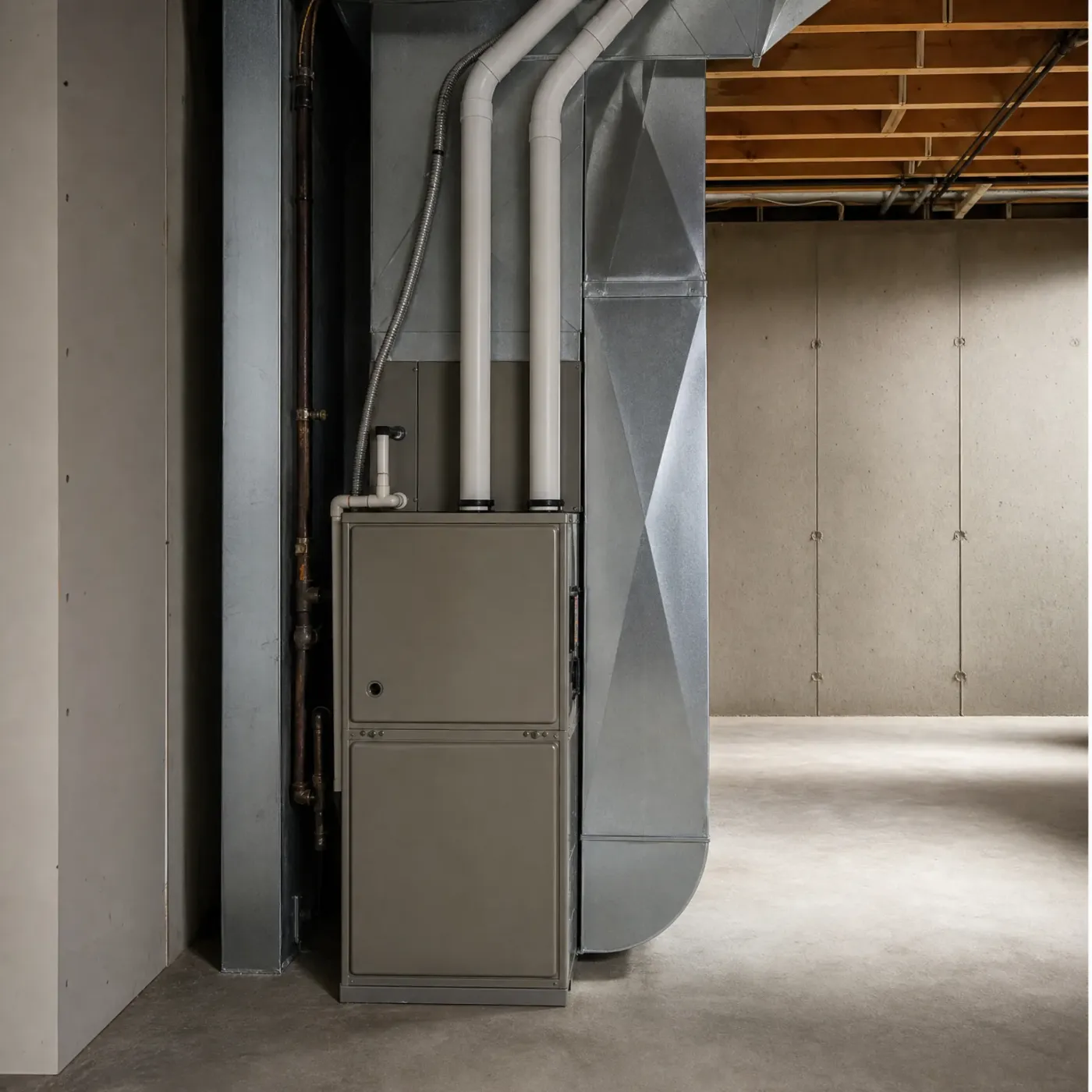
A gray high-efficiency furnace in a basement, connected to sheet-metal ductwork on the left and white PVC vent pipes above, with black gas and drain piping and an exposed wood-stud wall with OSB sheathing on the right.
After you get your furnace installation

A gas furnace runs through the same steps every time it fires. The igniter glows, the gas valve opens, the burners catch, and the blower starts pushing warm air once the heat exchanger is hot enough. That heat exchanger is the part that eventually gives out. It heats and cools every single cycle for years, and that's what cracks it open in the end. Short-cycling, where the furnace shuts off and restarts every few minutes instead of running a full cycle, speeds that wear along and puts extra strain on the igniter too. Not every shutdown means the furnace is dying, though. Dust on the burners or a dirty flame sensor will trip the safety switch and shut things down even when the furnace itself is fine. If your furnace vents through a chimney shared with a water heater, the sizing has to be right for both appliances, and that affects how long either one lasts. Yearly service catches the heat exchanger before it cracks and keeps the burners and flame sensor clean, which is the real reason a serviced furnace tends to outlast one left alone.

How a Furnace Actually Fails

  • A gas furnace fires through the same order every cycle: the igniter glows, the gas valve opens, the burners light, and the blower kicks in once the heat exchanger is warm.
  • The heat exchanger is the part that wears out the furnace, since it cracks open after years of heating and cooling with every cycle.
  • A furnace that short-cycles, turning on and off every few minutes instead of running a full heating cycle, puts more wear on the igniter and the heat exchanger than one that runs steady.
  • Dust and debris on the burners or in the flame sensor cause the furnace to shut down early as a safety response, not because the furnace itself is failing.
  • A furnace that vents through a chimney it shares with a water heater has to be sized and matched to that chimney, which affects how long both appliances hold up.
  • Yearly service checks the heat exchanger for cracks and cleans the flame sensor and burners, which is why a serviced furnace usually outlasts one that never gets checked.
A gray high-efficiency furnace with white PVC vent pipes stands against a concrete basement wall beside sheet-metal ductwork, a small condensate pump on the floor, and exposed wood framing at left.
A furnace still running clean draws air evenly and holds its heat without groaning or cycling short, year after year.
A gray sheet-metal furnace with flue pipe and adjacent ductwork stands against a stone basement wall on a concrete floor, with white PVC and metal pipes running nearby.
A furnace rusting at the base or cracking its exchanger is running on borrowed time, no matter how many winters it has left in it.
A gray-haired bearded man in a dark coat and scarf dusted with snow stands smiling in a dimly lit entryway with a white front door, a side table with a lit lamp, an oval mirror, and a patterned rug.
An older bearded man in a dark snow-dusted coat and gray scarf stands just inside a dimly lit home entry, with a framed picture, lit table lamp, and an adjoining room with a fireplace behind him, and snow visible through the open door.
A gray-haired, bearded man in a dark snow-dusted coat stands smiling in a dimly lit entry hall with a staircase, a lit table lamp, a framed picture, and a living room visible through a doorway.
An older man with gray hair and a beard, wearing a dark jacket dusted with snow, stands smiling in a dimly lit hallway with lamps and a living room visible behind him.

A furnace pro near you

Answer a few questions instead of calling shop after shop.

No fee to send it, and nothing to sign.

A beige residential gas furnace with white PVC vent pipes, copper and yellow gas lines, and adjacent sheet-metal ductwork stands on a concrete floor beside a plain white wall.

What a yearly checkup catches

A furnace technician checks the heat exchanger for cracks, cleans the burners, and tests the igniter and flame sensor during a yearly visit. Dirt and corrosion on these parts make the furnace work harder for the same heat, and that strain shortens its life. Skipping that yearly check doesn't always kill a furnace young, but it removes the thing most likely to catch trouble before it turns into a cracked exchanger or a dead blower motor.

A gray high-efficiency furnace with white PVC vent pipes and metal ductwork stands on a concrete floor beside a plain off-white wall in a basement.

Why the exchanger decides the rest

Every other part in a gas furnace, the igniter, the gas valve, the blower motor, can be replaced on its own without touching the rest of the unit. The heat exchanger can't. It's welded into the cabinet, and once it cracks, the furnace is done, because a cracked exchanger can leak combustion gas into the air your blower pushes through the house. That single part is why 15 to 20 years shows up as the number instead of a wider range.

Is your furnace showing its age

You might notice the burners take a second or two longer to catch, or the furnace runs longer to reach the same temperature it used to hit fast. Some rooms stay cooler than others. You hear a bang at startup, or a rattle from the cabinet that wasn't there last winter. Short cycling, where it fires on and off every few minutes, is another sign. Rust around the base or near the flue pipe matters too. A furnace that struggles like this through a Massachusetts winter is working harder on gas it still has to pay for, and if the heat exchanger is the cause, it puts carbon monoxide into a house that depends on that furnace through the coldest months.

A gray gas furnace stands on a concrete basement floor, connected to sheet-metal ductwork, white PVC vent pipes, and a yellow gas line, with plastic sheeting covering the walls.

A furnace running right

A furnace like this is tied into clean ductwork, a gas line, and PVC venting that all do their job without strain. It draws air evenly, fires on the first try, and heats the house without drama. This is what 15 to 20 years of upkeep looks like from the outside.


A metal furnace with louvered panels stands against a concrete basement wall, connected to sheet-metal ductwork and a round flue pipe, with wooden framing posts and a pipe nearby.

A furnace on its way out

Dust built up on the cabinet, copper gas lines instead of black pipe, and a look that says this unit has seen a lot of winters. None of that alone means it's done, but paired with slow starts or uneven heat, it's worth having someone look at before it fails on the coldest night of the year.

A woman wrapped in a thick beige fleece blanket sits on a sofa with an open book on her lap, beside a lit table lamp, with a frost-covered window behind her.
An older woman with gray hair in a bun and glasses, wearing a beige knit sweater, smiles while looking to the side in a warmly lit kitchen, with a loaf of bread on the counter in the foreground and a snowy scene outside the window.

Winter nights average 21°F statewide

At 21°F overnight, your furnace is running most of the night, every night, from December through February. That's the stretch that wears on the heat exchanger and burners most. A furnace that's kept up with yearly service handles those cold nights for 15 to 20 years. One that's been skipped starts to strain long before then.

NOAA nClimDiv 1991-2020 county normals weighted by homes

  1. The thermostat calls for heat and the igniter starts to glow.

  2. The gas valve opens and sends fuel to the burners.

  3. The burners light off the hot igniter in a straight row.

  4. Burning gas heats the metal walls of the heat exchanger.

A smiling man in a denim shirt and white t-shirt stands in an open dark doorway of a stucco house, facing a woman with long brown hair and a green jacket seen from behind in the foreground.

15 to 20 years, if the furnace gets the care that lets it get there

A gas furnace in Massachusetts that's serviced every year has a real shot at 15 to 20 years before the heat exchanger or the burners give out. One that's never been looked at tends to fall short of that, especially after enough winters at 21°F overnight. Where your furnace lands in that range comes down to whether it got that yearly attention and how it was installed in the first place.

If yours is showing the signs, longer cycles, cooler rooms, a bang or rattle at startup, the next step is getting someone qualified to look at it rather than guessing from the thermostat. You can be matched with a contractor who installs furnaces built for Massachusetts winters and works with what your house already has for ductwork and venting. They'll reach out to you directly, so there's no list of installers to call, no explaining the same symptoms three times over, no quotes to sort through on your own.

A living room corner with a light beige sofa holding a textured taupe cushion, a large ceramic vase of olive branches by a window, a framed neutral artwork on the wall, and a dark bowl with stacked books in the foreground.
A gray high-efficiency furnace in an unfinished basement, connected to sheet-metal ductwork and two white PVC vent pipes, with copper piping and exposed wood floor joists nearby.

A local pro for your furnace installation

Answer a few questions

Describe your furnace job once, to one pro.

Sending the form costs nothing.